


I'm skating at the local rink and I'm talking to a woman who I haven't seen in years.
"Homeschooling huh? Well my son would have benefited from that. What i really would have liked him to attend though is private school."
And then, "kids need to learn how to socialize." Oh God. Here we go again. I draw her attention to 3 other families (all friends of ours) skating along side of us. "Yeah but they have to learn how to grapple with other kids. Ya know?"
No. I don't know. They need to learn how to 'grapple' with all kinds of people. They need to learn how to get along with people of all ages. Period.
When will these well meaning folk learn that it doesn't have to happen in the context of school? To live well in society with others, kids need opportunities to be in the WORLD more, not less
(that is, stuck in school).
At school you learn facts and figures (and frankly you can learn these anywhere) but school doesn't MAKE a person.
I've said it before and I'm saying it again; school is not a good place for kids. School is a contrived situation. Get it finally. School is a fake. It is not real.
BEE
Sunday, December 9, 2007
Thursday, December 6, 2007

Wednesday, December 5, 2007
weather report
Labels:
radio4all
0
comments

The latest update on radio4all -Shawn and David are still working to get the server back. They are having to reinstall the operating system which became corrupted. I hope we'll be back soon.Hopefully some results soon, we have grown very accustomed/dependent on this web site.

Monday, December 3, 2007
coffee signs


Thursday, November 29, 2007
r4all down
Labels:
radio4all,
technology
0
comments
Seems Radio4all.net was down yesterday morning when CFMU was trying to download our latest show, so any Hamilton area listeners would not have heard the new show, nor anyone trying to access the show from the web site. It seems that the site was back on line later in the day, and downloading will have resumed.
This is not something that is in our (i.e. radio free school's) control, and it happens occasionally - but not frequently - at radio4all.
It is an amazing service for a show like ours to have the portal of radio4all there to upload our shows to the web, so please support them if you can.
This is not something that is in our (i.e. radio free school's) control, and it happens occasionally - but not frequently - at radio4all.
It is an amazing service for a show like ours to have the portal of radio4all there to upload our shows to the web, so please support them if you can.
Tuesday, November 27, 2007
the show must go on: getting your homeschooler to the ivory tower
Labels:
Radio,
university
0
comments

College Bound Homeschooler?
interview - Jon Reider, Director of College Counseling at San Francisco University High School. Former Senior Admissions Officer at Stanford University.
music - Super Sun Natural, Tom Wilson, Dog Years
tech - beatrice, randy
podcast - www.radio4all.net/proginfo.php?id=25695
"It is improper for older people to keep saying...that activity of the young is 'counterproductive.' It is our business to do something more productive that they can join if they want to."
Paul Goodman
--
RADIO FREE SCHOOL an all volunteer show by, for and about Un-schoolers/Home Learners.
Check out our blog at http://radiofreeschool.blogspot.com or our web site at http://radiofreeschool.ca/
Saturday, November 24, 2007
faceless gimmick
Labels:
DIVA,
Faceless Gimmick,
video
0
comments
Another dundas independent video association production, this one featuring un-school band Faceless Gimmick: doing a cover of the Dixie Chicks' "Wide Open Spaces."
The band's first public performance...average age of band members is 12 (youngest 9-years, oldest 13-years).
Friday, November 23, 2007
Friday, November 16, 2007
no picnic
Labels:
minutemen,
parent in midlife,
video
0
comments
One of my favourite bands from the 80's - and a very cute video:
Tuesday, November 13, 2007
Kit Chat
Labels:
Kit Pearson,
Radio,
Road Trips,
small press
0
comments
Download the latest radio free school here
interview - Kit Pearson http://www.kitpearson.com/
- Toronto Small Press Fair - Bronwyn Kay
music - Careless, Drive-By Truckers, Decoration Day
-Big Boned Gal (Remix), K.D. Lang, Alberta: Wild Roses, Northern Lights
tech - beatrice and randy
"Definitions pin things down, they limit the prospects for creativity and diversity. A definition, implicitly attempts to reduce all possible variations of a concept to a single pithy phrase."
Ian Stewart, Letters to a Young Mathematician
Saturday, November 10, 2007
Small Pressure
Labels:
curdled way,
kitty corner,
poetry,
small press
0
comments

Sell sell sell. Three zine-makers with an array of zine material at the Radio Free School table at the Toronto Small Press Fair (Nov. 10) - At our table Kitty Corner proved the top seller, followed by Curdled Way, then World Wide Zine (France issue) and Poems.
We had a lovely time and our friendly neighbour Drew Simmie was a pleasure to hang out with, the un-schoolers making great use of his fine fountain pen to sign autographs!

Friday, November 9, 2007
Small Time Toronto
Labels:
Road Trips,
small press,
zines
0
comments
Any Radio Free School listeners in the Toronto area are welcome to come and visit some of the rfs team on Saturday at the Toronto Small Press Book Fair.
The kids will have their respective zines for sale: Curdled Way, Poems, and the ever popular Kitty Corner.
The event unfolds at Trinity St. Paul's Centre, 427 Bloor St W, Toronto from 11am-5pm on Saturday, November 10.
The kids will have their respective zines for sale: Curdled Way, Poems, and the ever popular Kitty Corner.
The event unfolds at Trinity St. Paul's Centre, 427 Bloor St W, Toronto from 11am-5pm on Saturday, November 10.
Tuesday, November 6, 2007
The Nature of Unschooling
Labels:
india,
unschooling,
youtube
0
comments
A film featuring some radio free school regulars is heading to India to be included in The 'Re-membering Nai Taleem: Real Learning for the 21st Century' Film Festival.
After posting our video on YouTube, we were contacted by manish of Shikshantar - The Peoples' Institute for Rethinking Education and Development who then invited us to send a copy to them for the festival, to be screened this summer.
What's exciting - besides being asked to contribute a short video - is to discover the great work they are doing on subjects close to our hearts.
Please pay them a visit by following this link
What's exciting - besides being asked to contribute a short video - is to discover the great work they are doing on subjects close to our hearts.
Please pay them a visit by following this link
Saturday, November 3, 2007
citizen kay
Labels:
citizenshift,
kitty corner,
nfb
0
comments

An unschooling dossier is being built over at citizenshift on a beta site, a web-based project of the national film board of canada.
radio free school is contributing material to the project, including Bronwyn's sideline project, Kitty Corner zine.
We'll be updating you once the entire project is stitched together.
Wednesday, October 31, 2007
poppin off kids
Labels:
video
0
comments
In the spirit of Halloween, the radio free school search engine found this (approved by radio free school film board)
Tuesday, October 30, 2007
JK and WW and Zinga Zinga
Labels:
Radio
0
comments
Warning! Spoilers for Harry Potter and the Deathly Hallows in the show...
reading - Zinga Zinga, by Dennis Lee, from Jelly Belly, read by Bronwyn Kay
- The Monkey's Paw, W.W. Jacobs, read by Beatrice Ekoko
music - Meet Ze Monsta, P.J Harvey, To Bring You My Love
tech - beatrice
download - http://www.radio4all.net/proginfo.php?id=25298
RADIO FREE SCHOOL an all volunteer show by, for and about Un-schoolers/Home Learners.
Check out our blog at http://radiofreeschool.blogspot.com or our web site at http://radiofreeschool.ca/
Contact us at radiofreeschool@gmail.com or P.O. Box 19, 1280 Main Street West, Hamilton ON, L8S 1C0.
radio free school for wednesday, october 31, 2007
interviews - Madeleine and Evelyna Kay about winning tickets to see J.K Rowling at the Winter Garden Theatre, Toronto, Oct. 23, 2007reading - Zinga Zinga, by Dennis Lee, from Jelly Belly, read by Bronwyn Kay
- The Monkey's Paw, W.W. Jacobs, read by Beatrice Ekoko
music - Meet Ze Monsta, P.J Harvey, To Bring You My Love
tech - beatrice
download - http://www.radio4all.net/proginfo.php?id=25298
RADIO FREE SCHOOL an all volunteer show by, for and about Un-schoolers/Home Learners.
Check out our blog at http://radiofreeschool.blogspot.com or our web site at http://radiofreeschool.ca/
Contact us at radiofreeschool@gmail.com or P.O. Box 19, 1280 Main Street West, Hamilton ON, L8S 1C0.
Thursday, October 25, 2007

Sunday, October 21, 2007

Wednesday, October 17, 2007
Creating a Cooperative Learning Center by Katharine Houk

Many people like to learn together in groups. Small groups. Katharine Houk explains why in a radio free school interview that learning is "a relational experience"- doing things together with people in the community "adds another dimension" to learning.
A learning center also meant for her and her children, learning things that they might not even have thought or known about- so it opens up opportunities.
If you agree with this premise and you think classrooms are far too large, too boring, with no room for creative juices to flow then maybe creating a learning centre might be the way to go.
Personally, there are many days that I feel like I would like to see such a center around here- just cart the kids off or let them walk to it alone and stay there all day. Let them experience all sorts of exciting workshops and courses (of their choice naturally).
I would avoid calling it a 'learning' center though. It really bugs me that the myth is still prevalent amongst us-learning takes place only in institutions.
I think I would go with something like 'Doing Center' or Making space; with the focus on the doing part.
Check out the book though - it's very useful and you might get inspired!
Thursday, October 11, 2007

Tuesday, October 9, 2007
reading the airwaves
Labels:
Climate Change,
Radio,
stories
0
comments
plunk the kids down in front of the radio and let radio free school entertain the little darlings for an half hour, kids reading to kids, with two stories pouring out of the tinny speakers in your kitchen:
http://www.radio4all.net/proginfo.php?id=25004 is the place to go to download it, baby! (or just click here)
Radio Free School, part of a healthy, balanced media diet for your children
- "Teach Us, Amelia Bedelia" By Peggy Parish, pictures by Lynn Sweat,read by Bronwyn Kay
- "Why are the ice caps melting? The dangers of global warming," by Anne Rockwell, Illustrated by Paul Meisel, read (and commented on) by Evelyna Kay
music - Across the Universe, The Beatles, Let It Be
editing - Beatrice Ekoko
production - Randy Kay
http://www.radio4all.net/proginfo.php?id=25004 is the place to go to download it, baby! (or just click here)
Radio Free School, part of a healthy, balanced media diet for your children
Wednesday, September 26, 2007
reclaiming street space
Labels:
car free,
Radio,
video
0
comments
this week's show looks at Car Free Week - and lays out the various events organized by volunteers at Transportation for Liveable Communities and MacGreen in Hamilton - interview with Randy Kay of TLC on the week, and the Parking Meter Party that marked Car Free Day on September 22. Download the show here.
Our friends at DIVA have made a 2 minute movie - a web version can be found, well, right here.
Our friends at DIVA have made a 2 minute movie - a web version can be found, well, right here.
Sunday, September 23, 2007
Car free day 2007
Labels:
community
0
comments
Wow! What a week end! Car free day was sunny and beautiful this year.
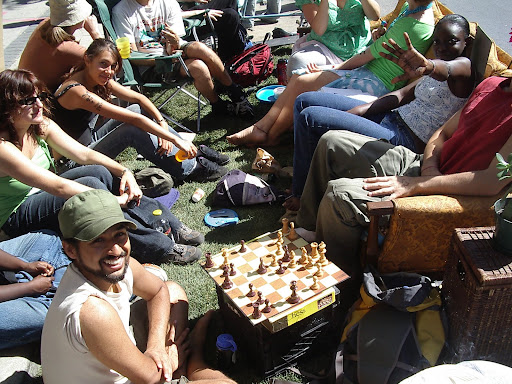
We attended a parking meter party- reclaimed space that is habitually allocated to the parking of vehicles.

It was transformed into a people friendly space with sod laid out on roadside parking spaces, and a 'found' comfy couch installed (one person didn't get up the entire time!)
People sat playing chess, blowing gorgeous HUGE soap bubbles, or sipping lemonade. My kids (sadly the only ones in attendance) happily got tattooed with face paint. There was a free bike repair clinic too and best of all, music! Wonderful violinist and guitar duo, they performed for over 2 hours!
This is an idea that should be extended into car free weekend. Check out the organizer's web site at tlchamilton.blogspot.com
by BEE
We attended a parking meter party- reclaimed space that is habitually allocated to the parking of vehicles.
It was transformed into a people friendly space with sod laid out on roadside parking spaces, and a 'found' comfy couch installed (one person didn't get up the entire time!)
People sat playing chess, blowing gorgeous HUGE soap bubbles, or sipping lemonade. My kids (sadly the only ones in attendance) happily got tattooed with face paint. There was a free bike repair clinic too and best of all, music! Wonderful violinist and guitar duo, they performed for over 2 hours!
This is an idea that should be extended into car free weekend. Check out the organizer's web site at tlchamilton.blogspot.com
by BEE
Wednesday, September 19, 2007
airing quality and an unbouncing
Labels:
Radio
0
comments

interview - Susan J. Elliott, Professor, School of Geography and Earth Sciences, Dean of Social Science
book reading - "In Which Tigger is Unbounced," The House at Pooh Corner, A.A. Milne - read by Beatrice and Madeleine
tech - beatrice
download - here
Saturday, September 15, 2007
Safe and Sorry

It’s the mid 90s when a child at a North Vancouver school climbs up a tree, falls out of it, hits her head and dies.
If you look at it from the perspective of the school board as Hern points out, it’s obvious that they can’t afford to get sued. On a deeper, more emotional level there’s the general view that ‘it’s all worth it if not another family has to go through this.’ It’s a view we’ve come to accept without challenge, no questions asked. But it’s a view that might be to our detriment.
Hern acknowledges that it’s a “terrible and difficult thing to say-to have to look at the family of that young girl and have to say that it’s worth it to let kids climb trees,” but the concern is that banning tree climbing is just another example of a cultural attitude towards a difficult problem that requires examining in far more depth.
Why? Because we’re talking about a phenomena that is seeping into every aspect of the way we make decisions.
Whether it’s got to do with neurotically installing surveillance cameras at every down town street corner or whether it’s about bombing Afghanistan or Iraq so that we can feel safe-let’s do it.
We know abduction is “over rated and that our level of fear doesn’t equate to the fact that in Canada, 3 kids a year get abducted,” Hern comments. Our fear is exaggerated.
It’s a distorted view that gets presented and that’s largely the fault of the media- ever ready to drum up sensationalism and how dangerous it is out there.
Hern refers to his home town where currently, there’s a tremendous push called ‘Project Civil Society’ to clean up the down town and the talk is centered on how dangerous the city has become.
The argument isn’t about there are too many poor people. Rather it’s about the city looking bad. Spitting and panhandling; “But if you look at every single statistic from violent crime to youth crime, to property crime all are down massively. In the same way we know the fear of abduction is overrated, still it’s in the foreground of our minds.”
Hern shares a personal experience; while at a summer horse camp, his daughter fell of a horse and broke her arm. What does that mean? he questions. Does that mean that no one should ever ride that horse again? Does that mean that I should sue them for not taking proper care?
The fact is “stuff happens. It’s part of life. Now would I be saying the same thing if she had fallen off and got brain injury and can’t feed herself. Would I be so sanguine then? Even if my kid had died, hopefully I would have the grace to not say that little girls should stop riding horses.”
It’s when we begin to reduce life to this “one big algorithm where it’s worth it or not,” as Hern puts it, that we get into a whole lot of trouble; distortions begin to arise when we talk about ethical or political decisions about what’s a good life.
“And when we begin to put it in that kind of catastrophic format, everything begins to tighten and narrow and of course nothing is worth it,” Hern reflects. “That’s not the place to make decisions. We have to be making ethical decisions first.”
We can’t allow safety discourses to over run all our rationality and all our ethical thinking.
Because what’s a good childhood? Hern has a ready reply; “One where kids can ride horses and climb trees. Do some kids get hurt? Yep. That’s the way it is.”
If we think back to our own childhoods, many of us will agree that we actively sought out challenging situations for ourselves; if there weren’t any, we’d create them. We would dare and double dare each other, we would go exploring, dig for buried treasure, seek the pot of gold at the end of the rainbow, rescue the prisoner from the dragon’s lair.
Our favorite books were about children on exciting adventures, testing their mettle, overcoming adversary. Excited by their bravery, we’d try to emulate our most admired characters. Who would want less for their own children?
If the idea is to raise our children to be responsible adults, risk-takers (that’s almost become a dirty word now) then they are going to require a lot more room in which to practice responsibility, “because when there are so many rules the adventure becomes breaking the rules not the adventure itself,” observes Hern. “And the result is kids end up with such a tiny space that their capacity for self reliance is completely muted.”
If kids don’t have opportunities to play more freely, if they aren’t allowed to explore and test their own limits to test the limits of their physicality, “they are never going to be able to do develop those capacities for making good decisions; and ironically the kind of decisions that they can keep themselves from harm more or less,” adds Hern.
We could, as Hern does, extrapolate the larger ideas about learning. Children have got to be able to explore different fields, delve into different areas of interest, begin to learn what they like or don’t like, how they thrive. They need to be able to do that themselves.
You want kids to learn for themselves and make decisions, but it doesn’t mean ‘carte blanche’ either warns Hern. “Obviously, you’re not going to let you kid wander out in traffic to learn about the power of cars. Parents and mentors have their roles too.”
He suggests that we keep this difficult conversation open and on-going at all levels; “we need to talk about it and say the thing that nobody wants to hear; that the safe choice is not the right choice all the time. It rarely is.”
Wednesday, September 12, 2007
cob inside and out
Labels:
Radio,
Road Trips
0
comments

COB BUILDING
Interviews - Georgie Donais (pictured), Cob builder, (Dufferin Grove Park, Toronto) Community Activist, Dancer, Graphic Designer. She and her husband unschool two children.
- Bronwyn (who loves cats)
Music - boil the breakfast early, the Chieftains, Best Of
- the Alberta Homesteader, Alan Mills, Classic Canadian Folksongs from Smithsonian/Folkways

Saturday, September 8, 2007
My family and other Animals; Movie Review
Labels:
Review
0
comments
Have you seen this movie? It's put out by the BBC Drama and it's about the life of home-educated British naturalist Gerald Durrell. My family watched it twice over the weekend. It's a heartwarming, funny narration of an eccentric family, who trade the damp weather of pre-WWII England for time on sun-shiny Corfu.
It's the perfect place for a budding scientist and Jerry thrives in this climate of abundance; bugs and much freedom to romp in the beautiful natural world. His older siblings, although often exasperated by one another's tendencies and personalities, allow one another to be who they are-and their mother is a brilliant example of good unschooling practise- "if you can control your children you're doing something wrong."
Hear hear!
It's the perfect place for a budding scientist and Jerry thrives in this climate of abundance; bugs and much freedom to romp in the beautiful natural world. His older siblings, although often exasperated by one another's tendencies and personalities, allow one another to be who they are-and their mother is a brilliant example of good unschooling practise- "if you can control your children you're doing something wrong."
Hear hear!
Friday, September 7, 2007
today...

Not everyday is this good. But let me mark it down as possible, and more, truly lived experience.
Wednesday, September 5, 2007
LIVE...with the DOCTOR

Radio Free School checks in at the CFMU "tent" at McMaster during "Clubs Fest, 2007" today, while "Doctor Don" looks on from his perch in the host chair.
In typical Radio Free School live fashion we fumbled our way through the half hour with: some dead air, some confused commands, some bad passes of the headphones, and that was the first 10 minutes...
We still had a decent time, but we much prefer to do the show on audacity first, editing out those things we don't want (see above).
Live Radio is a blast, but you kind of need to be in shape for it.
Saturday, September 1, 2007
Radio Free school Interview; Grace Llwellyn and Beatrice Ekwa Ekoko

Listen to the interview
May 2003- May 2004; Guerilla learning with Grace Llwellyn show 36
I wrote a book called the Teenage liberation Handbook; how to quite school and get a real life. I ran a summer camp for home school teenagers and I‘ve done some other writing books, and other work with homeschoolers especially teenagers.
Why the interest with teenagers in particular?
I think a lot of people, when they are teenagers, it’s kind of the first time they are looking around and thinking about defining themselves as human beings- it’s such a very powerful time and I felt drawn to work with kids at that stage.
And two people in their late 20s that I’ve recently been talking with, their parents didn’t let them try school and they still to this day wonder you know, ‘well. What would it have been like?” So I think for some kids there’s really a need to prove themselves to check out what is this thing that everybody else in our society does because there’s curiosity and wondering about what they are missing out on. And for a lot of them, that runs it’s course if they are allowed to explore it.
And depending on what the relationships are like- sometimes it really helps to bring in a third party, another adult who both the parent and the teenager respect or feel comfortable with and let that person help draw out the teenager and help that teenager form some ideas about what their direction should be in life and then help brainstorm ways to support the kid in realizing some of that. I think it really helps to have some intentional leadership on the part of adults; not in the sense of like, ‘okay. This is what you are going to do now,’ but ‘okay. You’re older now and it’s a new time in your life. And I want to help you in studying some new intentions and articulating some goals. How can I best support you in that?’ taking leadership in that way.
And my brothers who thought that it was a great book said, ‘Yeah. That would be pretty cool. It won’t happen of course because it’s just too radical but..Yeah it’s a nice thought.’
It was kind of a circuitous path. I taught school for three years before I wrote the teenage liberation handbook and although I had a lot of difficulty being in a school I really loved working with teenagers. And I missed that a lot and after I quit, for a while I felt satisfied with the correspondence I had with a lot of teenagers after they started writing to me, after they read my book. But pretty soon I thought, ah! I never work with kids one on one anymore. So I first opened a resource center here in Eugene, Oregon for mostly teenage homeschoolers with the thought that then I would get the pleasure of working with kids in person again.
Guerrilla Learning; How to give your kids a real education with or without school. By Grace Llewellyn and Amy Silver.
Labels:
guerrilla learning,
unschooling
0
comments
Grace and Amy have had enough of the ivory tower that is un-schooling and home based learning which hoards it’s knowledge of how children really learn, for the precious few. So they have set out to blast out our secrets to clueless schoolers with their book Guerrilla Learning; How to give your kids a real education with or without school. They are selling the goods to anyone who wants them; all can now enjoy the exciting methods of imparting knowledge that is inherent to this approach. Home based learning, natural learning, life long learning, interest based learning, call it what you will, it works. Even if it isn’t a reality for you, you can still find ways to benefit from the world we un-schoolers dwell in, we who have already reclaimed our right to directing our own learning.
I mean, it is becoming obvious to mainstreamers from all walks of life that these non intrusive ways of educating kids are hugely successful- Broadly speaking home based learners are indeed a resourceful bunch; generally these families know their kids very well. They know their talents, their interests, and they usually can find ways in which to fuel their passions further. They are very good at searching out opportunities for their kids and being supportive of their interests too.
Amy and Grace want to impart some of this know-how to all of you on the outside, so that your kids won’t loose out on the miracle that is learning beyond institutions and the system.
What’s that I hear from the non-schoolers? You mean this doesn’t sound like your happy homeschool? Do I hear anxious sounds of uncertainty and self doubt? Panic in the rear? Don’t worry! If the well has dried up, the “fire to kindle’ never got pass the spark, even you, the un-schooling family will gain a boost from immersing your selves in this book. (Admit it- it does happens- we get lazy and loose too you know. So you can wipe the smirks of your faces, un-schoolers, and don’t be in such a hurry to dismiss this book). “Guerrilla Learning” is at your service and to the rescue!
So what is this book all about? Well, to help you change your stagnant and long outdated ways of thinking about education and how you get it, these fine gals have proposed five basic keys to guerrilla learning whether your kids are in or out of the dungeon called school. (By the way they nicked the phrase “guerrilla learning” of John Taylor Gatto.
If you don’t know who that is, it’s up to you to find out). These are opportunity, timing, interest, freedom, and support.
Opportunity. More fundamental than attending elite schools and universities is a person’s “attitude, sense of personal power and possibility, and comfortable familiarity with a wide range of subjects and activities.” So as they say, “ read. Write. Talk. Play music together. Go see dance and theater and paintings. Read poetry, write poetry..build things... Provide them with resources, materials, people, places to go to of course. But “do these only out of love.”
Next is timing. “If we could wave a magic wand and change American schools, we would change this: the idea that earlier is better, that there is some intrinsic value in children’s learning things (1) on cue and (2) early. Our experience, and a large body of research in developmental psychology, insists that there is enormous, mostly unrecognized value in children simply being allowed to learn things when they are ready,” they write. And then go into detail.
Interest- jump on it when it rears it’s inquisitive heads. Don’t wait until it dies away. But don’t be too pushy- the child must own her own interest. You might not even recognize it for what it is. Amy and Grace to the rescue again. Don’t overlook or under rate your child’s interest- just because it doesn’t fit your narrow system of evaluation. Yeah, it’s video game all day long, or sexist comic strips- but there might be a diamond in the rough for all you know. Build on this interest.
Freedom. Ah freedom, the biggy! We never give them enough of it. It’s always hurry, hurry, hurry. But let them have the time and space to move as they wish, to choose, when, where and how. The freedom of choice to discover and follow their own interests and impulses and to “commit oneself.” We need to stop being the nosy parkers that we are and mind our own businesses if you please.
Next is support. What’s the use of being brilliant if there is no support mechanism to bloom in? This means explaining, celebrating, witnessing and listening, listening, even when you are bone tired and not in the mood.
Each of these five keys are covered in depth with exercises you the adult can complete at the end of each key ( this is a self-help book after all) to get the old juices flowing.
The book is packed with resources, books to read, web sites to go to for inspiration, ideas to get things rolling; arts for example- art museums, galleries- keep art supplies handy at all times, explore architecture ,textile design, film making, jewelry making, statues at the park, sing songs together, play music. The list goes on...Physical science- stock up on science experiment books, simple equipment, hand lens, graph paper, anatomy charts, newspapers that include astronomy news. “Choose a small space in your house to transform into a cornucopia of science inspiration...cover hall ways with inviting, informative charts, maps or posters about dinosaurs, the phases of the moon, the wild flowers of your region...”
In a helpful fashion, the book relates concepts and ideas back to Amy’s kids, Grace’s experiences and other parents input.
The book ends with appendices of valuable information which include alternatives to traditional schooling for those who don’t have the guts to un-school. Also included are organizations that promote alternative learning such as “Creating Learning Communities”, EnCompass, Power to the Youth and Genius Tribe, started up by Grace Llewellyn herself.
Guerrilla Learning is about getting for your kids a real education with or without school as the rest of the title says. It’s also about changing your own self- getting into the thrill and joy of following your muse to quote a cliche.
Guerrilla Learning is an absolute gold mine. It is a must for any family who cares about their children’s education, and honouring their children’s calling. Pick it up at your local library, buy it if you can. Beg, borrow or steal but get it. You’ll be sorry if you don’t!
*****
Published by John Wiley & Sons, Inc 2001
Tuesday, August 28, 2007
guerrilla gardeners
Labels:
Climate Change,
Radio
0
comments

guerrilla gardens - hear the show here (AKA "creeping gardens, and other popular crimes")
interviews - beatrice ekoko, climate change challenge project manager, environment hamilton
- andy brown, guerrilla gardener, toronto public space committee
book review - the prophet of yonwood, by Jeanne DuPrau, reviewed by Bronwyn
music - fall on me, REM, Lifes Rich Pageant
tech - beatrice and randy
"...they should not play life, or study it merely, while the community supports them at this expensive game, but earnestly live it from beginning to end. How could youths better learn to live than by at once trying the experiment of living?"Henry David Thoreau
Tuesday, August 21, 2007
wild dining
Labels:
Radio
0
comments

THIS WEEK'S SHOW:
download it here: http://www.radio4all.net/proginfo.php?id=24367
interview - Dieter Staudinger, Spiritual Psychotherapist (pictured with the kids)
music - How Deep In The Valley, Sarah Harmer, I'm a Mountain
tech - beatrice ekoko, randy kay
"Education ought to be viewed as a process of development and exploration, rather than as one of repressing a child's instincts and inculcating obedience and discipline. Children learn best when they feel good about themselves, others, and the world. The best education, therefore, would orient the child to the world, facilitating the child's learning from others and from his or her environment. Furthermore, it would engage children as fully as possible (taking advantage of all the senses), encouraging them to develop and value their own abilities as well as to cooperate with others. Education, that is, should be active, noncompetitive, and as nondirective as possible, relying heavily on children's natural curiosity."Free Women of Spain, Martha A. Ackelsberg.
Tuesday, August 7, 2007
carpet crawlers
Labels:
Radio
0
comments

Bugging the Entomologist
Wednesday, August 8, 2007
interview - Marvin Gunderman, Technical Coordinator, Curator of Entomology, Insect Taxonomist, Dept. of Biology, McMaster University
music - "carpet crawlers", Genesis, Lamb Lies Down
edit - randy
download as MP3/Podcast: http://www.radio4all.net
Thursday, August 2, 2007
Final Harry Potter tome is "greenest book in publishing history"
This is a neat piece of information fro those who environmentalists who love Harry Potter;
The final installment of the mugglicious series is said to be the greenest book in publishing history -- a good thing, since it's set sales records at retailers like Amazon.com and Barnes & Noble. Sixteen publishers around the world used eco-friendly paper for the edition, including U.S. publisher Scholastic, which went the conventional route for the last Harry book and faced a boycott as a result. In all, says Markets Initiative, a Vancouver-based group that helps publishers go green, the switch for Harry Potter and the Deathly Hallows has saved nearly 200,000 trees and avoided almost 8,700 tons of carbon dioxide emissions.
This from the Daily Grist, July 20th
The final installment of the mugglicious series is said to be the greenest book in publishing history -- a good thing, since it's set sales records at retailers like Amazon.com and Barnes & Noble. Sixteen publishers around the world used eco-friendly paper for the edition, including U.S. publisher Scholastic, which went the conventional route for the last Harry book and faced a boycott as a result. In all, says Markets Initiative, a Vancouver-based group that helps publishers go green, the switch for Harry Potter and the Deathly Hallows has saved nearly 200,000 trees and avoided almost 8,700 tons of carbon dioxide emissions.
This from the Daily Grist, July 20th
Wednesday, August 1, 2007
Book Review
Discipline without Distress; 135 tools for raising caring, responsible children without time-out, spanking, punishment or bribery by Judy Arnall (2007)
If you've run out of ideas on what to do when your kid is driving you up the wall and hanging him out the window by his ankles is looking like a reasonable thing to do, if you feel like you've forgotten any wise parenting knowledge you ever had, or if the case is that you've never had any in the first place then Discipline Without Distress by Judy Arnall could be the book for you.
If you can be self-disciplined enough to plough through its many pages, you will discover therein, a veritable gold mine of helpful tips to assist you in your parenting journey.
“Parenting is the hardest job on earth,” Arnall doesn't need to tell us that but the premisses of her book underlines that which we often fail to see; We are not raising children. We are raising adults.”
And what we do today, how we respond to our children in the immediate, corresponds to the adult of tomorrow.
So what Arnall advices us to focuses on is relationship building with our child. This is the most important idea in the entire book. The parenting relationship is a love relationship; “ Just remember Newton's law: for every action, there is an equal and opposite reaction. There are two people in your relationship, you and your child, and at the end of the day, your relationship is all you have,” warns Arnall.
What is necessary then, is that you treat your child “with the respect you would afford an adult in today's society.”
Punishment is not part of the picture- you can discipline your child and maintain good communication without it.
Which brings me to the word discipline; for many its not a comfortable word. It often connotes the idea of control, can bring up painful memories of spankings and yellings, it can remind us that we are fearful our children have no regard for our values!
But Arnall brings new meaning to the word- it's about respecting each other, it's about a democratic nurturing way of parenting. It's also about self discipline for both parent and child. It's fundamental to living in a healthful relationships with others and we can all learn it in a kind and loving way.
An in depth look at anger triggers, behaviour problems, the need to model what we expect our children to be like, all these are invaluable tools and advice for the adult interested in preserving intact the precious parent child bond.
By BEE
copyright 2007 by Judy Arnall jarnall@shaw.ca
www.professionalparenting.ca
Tuesday, July 31, 2007
Mischief Managed
Labels:
Radio,
Review
0
comments
Well, we just managed to pull the Potter show together after staying up past the bus hours with a bunch of potter fans at Bryan Prince Book Seller's Potter Party in our little part of the world.
Prince's Bookstore is a tiny narrow shop in a walkable community (Westdale) and features high shelves that patrons ascend on a movable ladder. Diagon Alley material, for sure. And of course owner operated by the marvellous man Bryan, and his wonderful staff.
He bought pizza for 500 people.
We ate it up and came up with this: Waiting for Potter
Sorry to the lady who asked me for I.D. when I was trying to interview the kids... I.D. ...at a dress up party! (I was wearing a cape and a fake moustache at the time)
Muggles! They are so suspicious.
The show is more of a dip into fandom, a brush with hype, and a bunch of nice people wearing funny clothes and buying books.
Click on the magic link (above) to find the show and download it.
Now that you've finished the book...
Prince's Bookstore is a tiny narrow shop in a walkable community (Westdale) and features high shelves that patrons ascend on a movable ladder. Diagon Alley material, for sure. And of course owner operated by the marvellous man Bryan, and his wonderful staff.
He bought pizza for 500 people.
We ate it up and came up with this: Waiting for Potter
Sorry to the lady who asked me for I.D. when I was trying to interview the kids... I.D. ...at a dress up party! (I was wearing a cape and a fake moustache at the time)
Muggles! They are so suspicious.
The show is more of a dip into fandom, a brush with hype, and a bunch of nice people wearing funny clothes and buying books.
Click on the magic link (above) to find the show and download it.
Now that you've finished the book...
Friday, July 20, 2007
Potter Party

Trelawny, and many potter fans in costume partied at Bryan Prince Books in Hamilton tonight. The party included a fortune teller, games and prizes, and fodder for an upcoming radio free school show. Only one parent rescued her children from being interviewed by a grown man with a badly drawn mustache and a video camera (two kids actually approached to guess that your's truly was dressed as Professor Lupin.)
More later, since the party went on beyond midnight (as it should) and we cabbed home late late late.
Funniest was the two kids dressed as Potter who got sorted into Slytherin (which coincidentally was my house).
Like I said: more later!
Sunday, July 15, 2007
ministry approved curriculum
Labels:
commentary
0
comments

Dolores Umbridge: Your previous instruction in this subject has been disturbingly uneven. But you will be pleased to know from now on, you will be following a carefully structured, Ministry-approved course of defensive magic. Yes?
Hermione Granger: There's nothing in here about using defensive spells.
Dolores Umbridge: Using spells? Ha ha! Well I can't imagine why you would need to use spells in my classroom.
Ron Weasley: We're not gonna use magic?
Dolores Umbridge: You will be learning about defensive spells in a secure, risk-free way.
Harry Potter: Well, what use is that? If we're gonna be attacked it won't be risk-free.
Dolores Umbridge: Students will raise their hands when they speak in my class.
[pauses]
Dolores Umbridge: It is the view of the Ministry that a theoretical knowledge will be sufficient to get you through your examinations, which after all, is what school is all about.
Harry Potter: And how is theory supposed to prepare us for what's out there?
Dolores Umbridge: There is nothing out there, dear! Who do you imagine would want to attack children like yourself?
Harry Potter: I don't know, maybe, Lord Voldemort!
Thursday, July 12, 2007
C, eh? N, eh? D, eh?
Labels:
commentary
0
comments

People say "How will the kids be part of the culture if they don't go to school?" "How will they be good citizens if they don't have a civic education from school?"
First of all, "are you talking about pop culture?" is what I'll ask. Because if you are, I can tell you, you can't avoid it (Unless you live in a basement and never see the light of day).
Believe me, I've tried. My kids don't go to school and we don't even watch tv. Yet.... they know everything about the latest fashions in clothing styles, they know Brat dolls, My scene dolls, Barbies, Sponge Bob. They know Hello Kitty and Hilary Duff. They know Disney world, Polly dolls, Build a bear, Canada Wonderland. Crocs, 'My story is makeover. I'm revealing my ignorance here- because I don't know the half of it. But you get the point.
My daughters get all the pop I can take courtesy of our neighbour. This little girl knows more about what is in then most 16 year olds. And she is 9!
So maybe you're talking Canadian culture? Maple syrup. Hockey. Cottage country in the summer. Soccer in the summer. Tobogganing in the winter? CBC radio? Canoing? But you obviously don't need to go to school to be exposed to these.
As to civic education, my response is that civics is active. It is current. Sitting in a classroom is not- that's passive and is not very empowering.
Frankly, parents who have their kids out of school are actually more likely to follow current events and expose their children to what is happening in the world. The very decision to home educate doesn't come easily. A great deal of thought is put into it. It's a responsibility that home education parents don't take lightly. If they've made that decision you can pretty much guarantee they are enlightened enough to allow their children to question everything- including authority.
More likely us not, unschooled kids are encouraged to consider how the world around them operates, how it affects them personally, what could be different about it. How can they impact it in turn.
The bigger questions are asked- the environment, freedom of speech, freedom to pursue your own education...These are not light ideas. They are powerful and empowering.
I think that's what a civic education at school might lack. It's just not dynamic enough in the sense that kids feel they can make a difference in their community - which is where it all begins right?
by BEE
Notes:

This is from my 11 year old daughter (E.K.) who likes to get her history and Geography lessons from reading fiction books. Right now she is reading Dear Canada Diaries ( all written by Canadian authors) such as Not a nickel to spare, If I die before I wake. A prairie as wide as the sea. No safe harbour. Winter of Peril. with nothing but Our Courage. Brothers far from home. Orphan at my door.
She says about this series "Awesome! So many facts. Especially No safe harbour and If I die before I wake. Both are tragic and about huge loses. If I die about the flu pandemic caused more death than the Great War. (WW1) No safe harbour tells the story of the Halifax explosion. Better than My Canadian Girl- which reaches out to young readers. The Dear Canada Diaries are more for my age."
Wednesday, July 11, 2007
...why?
Labels:
ever noticed?,
photos
0
comments

Why Grass? Why pesticides? Why cut? Why stripes?
O, for a future that lets nature back in!
Tuesday, July 10, 2007
whole lotta gardens and trees and things
Labels:
Radio
0
comments

this week on radio free school:
plant & page download it here
interviews
- Caleb in his garden
- Randy and Bronwyn in their container garden
- Juby Lee and James during the Dundas Tree Count Inventory (Environment Hamilton project)
reading
- Madeleine reads Ladybug Garden by Celia Godkin
music
- Daybreak, Harry Nilsson, Everybody's Talking (Very Best of)
- Field Holler, Back Roads to Cold Mountain, T.J. Chesser
- glockenspiel impromptu, Evelyna
- Bimba dagli occhi, Madama Butterfly, Puccini
(the show has really nothing to do with Robert and Jimmy, but boy, do they rock!)
Sunday, July 8, 2007
Summer smile
Labels:
photos
0
comments

Caleb gets into the (belated) summer solstice spirit with a berry-smeared chin and a lovely smile!
Friday, July 6, 2007
sounds
Labels:
Radio,
technology
0
comments

The learning curve on new sound editing software (audacity) is cresting, so we hope the quality of the show recordings are heading back into the "good" range as we figure things out.
There are always challenges to getting it right including: our recording equipment (a digital video camera) is six years old and acting older with loose connections that make the audio good or bad depending on how you shake it; competing with child-generated music and general household noise while trying to edit the show, and (partly due to the previous reason) the fact that we often edit in the wee hours after long days of work.
But when the equipment is working, and the humans at the controls are awake, we hope to get the highest possible quality sound out to the airwaves and to the net for you.
You can help by letting us know what you think, about anything we are doing with radio free school. Anytime.
radiofreeschool (at) gmail (dot) com


Subscribe to:
Posts (Atom)