


this week's show looks at Car Free Week - and lays out the various events organized by volunteers at Transportation for Liveable Communities and MacGreen in Hamilton - interview with Randy Kay of TLC on the week, and the Parking Meter Party that marked Car Free Day on September 22. Download the show here.
Our friends at DIVA have made a 2 minute movie - a web version can be found, well, right here.
Wednesday, September 26, 2007
Sunday, September 23, 2007
Car free day 2007
Labels:
community
0
comments
Wow! What a week end! Car free day was sunny and beautiful this year.
We attended a parking meter party- reclaimed space that is habitually allocated to the parking of vehicles.

It was transformed into a people friendly space with sod laid out on roadside parking spaces, and a 'found' comfy couch installed (one person didn't get up the entire time!)
People sat playing chess, blowing gorgeous HUGE soap bubbles, or sipping lemonade. My kids (sadly the only ones in attendance) happily got tattooed with face paint. There was a free bike repair clinic too and best of all, music! Wonderful violinist and guitar duo, they performed for over 2 hours!
This is an idea that should be extended into car free weekend. Check out the organizer's web site at tlchamilton.blogspot.com
by BEE
We attended a parking meter party- reclaimed space that is habitually allocated to the parking of vehicles.
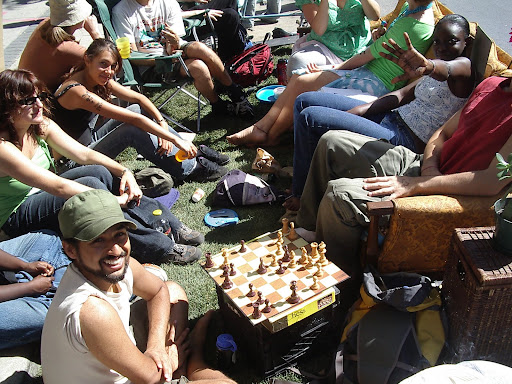
It was transformed into a people friendly space with sod laid out on roadside parking spaces, and a 'found' comfy couch installed (one person didn't get up the entire time!)
People sat playing chess, blowing gorgeous HUGE soap bubbles, or sipping lemonade. My kids (sadly the only ones in attendance) happily got tattooed with face paint. There was a free bike repair clinic too and best of all, music! Wonderful violinist and guitar duo, they performed for over 2 hours!
This is an idea that should be extended into car free weekend. Check out the organizer's web site at tlchamilton.blogspot.com
by BEE

Wednesday, September 19, 2007
airing quality and an unbouncing
Labels:
Radio
0
comments

interview - Susan J. Elliott, Professor, School of Geography and Earth Sciences, Dean of Social Science
book reading - "In Which Tigger is Unbounced," The House at Pooh Corner, A.A. Milne - read by Beatrice and Madeleine
tech - beatrice
download - here
Saturday, September 15, 2007
Safe and Sorry

It’s the mid 90s when a child at a North Vancouver school climbs up a tree, falls out of it, hits her head and dies.
If you look at it from the perspective of the school board as Hern points out, it’s obvious that they can’t afford to get sued. On a deeper, more emotional level there’s the general view that ‘it’s all worth it if not another family has to go through this.’ It’s a view we’ve come to accept without challenge, no questions asked. But it’s a view that might be to our detriment.
Hern acknowledges that it’s a “terrible and difficult thing to say-to have to look at the family of that young girl and have to say that it’s worth it to let kids climb trees,” but the concern is that banning tree climbing is just another example of a cultural attitude towards a difficult problem that requires examining in far more depth.
Why? Because we’re talking about a phenomena that is seeping into every aspect of the way we make decisions.
Whether it’s got to do with neurotically installing surveillance cameras at every down town street corner or whether it’s about bombing Afghanistan or Iraq so that we can feel safe-let’s do it.
We know abduction is “over rated and that our level of fear doesn’t equate to the fact that in Canada, 3 kids a year get abducted,” Hern comments. Our fear is exaggerated.
It’s a distorted view that gets presented and that’s largely the fault of the media- ever ready to drum up sensationalism and how dangerous it is out there.
Hern refers to his home town where currently, there’s a tremendous push called ‘Project Civil Society’ to clean up the down town and the talk is centered on how dangerous the city has become.
The argument isn’t about there are too many poor people. Rather it’s about the city looking bad. Spitting and panhandling; “But if you look at every single statistic from violent crime to youth crime, to property crime all are down massively. In the same way we know the fear of abduction is overrated, still it’s in the foreground of our minds.”
Hern shares a personal experience; while at a summer horse camp, his daughter fell of a horse and broke her arm. What does that mean? he questions. Does that mean that no one should ever ride that horse again? Does that mean that I should sue them for not taking proper care?
The fact is “stuff happens. It’s part of life. Now would I be saying the same thing if she had fallen off and got brain injury and can’t feed herself. Would I be so sanguine then? Even if my kid had died, hopefully I would have the grace to not say that little girls should stop riding horses.”
It’s when we begin to reduce life to this “one big algorithm where it’s worth it or not,” as Hern puts it, that we get into a whole lot of trouble; distortions begin to arise when we talk about ethical or political decisions about what’s a good life.
“And when we begin to put it in that kind of catastrophic format, everything begins to tighten and narrow and of course nothing is worth it,” Hern reflects. “That’s not the place to make decisions. We have to be making ethical decisions first.”
We can’t allow safety discourses to over run all our rationality and all our ethical thinking.
Because what’s a good childhood? Hern has a ready reply; “One where kids can ride horses and climb trees. Do some kids get hurt? Yep. That’s the way it is.”
If we think back to our own childhoods, many of us will agree that we actively sought out challenging situations for ourselves; if there weren’t any, we’d create them. We would dare and double dare each other, we would go exploring, dig for buried treasure, seek the pot of gold at the end of the rainbow, rescue the prisoner from the dragon’s lair.
Our favorite books were about children on exciting adventures, testing their mettle, overcoming adversary. Excited by their bravery, we’d try to emulate our most admired characters. Who would want less for their own children?
If the idea is to raise our children to be responsible adults, risk-takers (that’s almost become a dirty word now) then they are going to require a lot more room in which to practice responsibility, “because when there are so many rules the adventure becomes breaking the rules not the adventure itself,” observes Hern. “And the result is kids end up with such a tiny space that their capacity for self reliance is completely muted.”
If kids don’t have opportunities to play more freely, if they aren’t allowed to explore and test their own limits to test the limits of their physicality, “they are never going to be able to do develop those capacities for making good decisions; and ironically the kind of decisions that they can keep themselves from harm more or less,” adds Hern.
We could, as Hern does, extrapolate the larger ideas about learning. Children have got to be able to explore different fields, delve into different areas of interest, begin to learn what they like or don’t like, how they thrive. They need to be able to do that themselves.
You want kids to learn for themselves and make decisions, but it doesn’t mean ‘carte blanche’ either warns Hern. “Obviously, you’re not going to let you kid wander out in traffic to learn about the power of cars. Parents and mentors have their roles too.”
He suggests that we keep this difficult conversation open and on-going at all levels; “we need to talk about it and say the thing that nobody wants to hear; that the safe choice is not the right choice all the time. It rarely is.”
Wednesday, September 12, 2007
cob inside and out
Labels:
Radio,
Road Trips
0
comments

COB BUILDING
Interviews - Georgie Donais (pictured), Cob builder, (Dufferin Grove Park, Toronto) Community Activist, Dancer, Graphic Designer. She and her husband unschool two children.
- Bronwyn (who loves cats)
Music - boil the breakfast early, the Chieftains, Best Of
- the Alberta Homesteader, Alan Mills, Classic Canadian Folksongs from Smithsonian/Folkways

Saturday, September 8, 2007
My family and other Animals; Movie Review
Labels:
Review
0
comments
Have you seen this movie? It's put out by the BBC Drama and it's about the life of home-educated British naturalist Gerald Durrell. My family watched it twice over the weekend. It's a heartwarming, funny narration of an eccentric family, who trade the damp weather of pre-WWII England for time on sun-shiny Corfu.
It's the perfect place for a budding scientist and Jerry thrives in this climate of abundance; bugs and much freedom to romp in the beautiful natural world. His older siblings, although often exasperated by one another's tendencies and personalities, allow one another to be who they are-and their mother is a brilliant example of good unschooling practise- "if you can control your children you're doing something wrong."
Hear hear!
It's the perfect place for a budding scientist and Jerry thrives in this climate of abundance; bugs and much freedom to romp in the beautiful natural world. His older siblings, although often exasperated by one another's tendencies and personalities, allow one another to be who they are-and their mother is a brilliant example of good unschooling practise- "if you can control your children you're doing something wrong."
Hear hear!
Friday, September 7, 2007
today...

Not everyday is this good. But let me mark it down as possible, and more, truly lived experience.

Wednesday, September 5, 2007
LIVE...with the DOCTOR

Radio Free School checks in at the CFMU "tent" at McMaster during "Clubs Fest, 2007" today, while "Doctor Don" looks on from his perch in the host chair.
In typical Radio Free School live fashion we fumbled our way through the half hour with: some dead air, some confused commands, some bad passes of the headphones, and that was the first 10 minutes...
We still had a decent time, but we much prefer to do the show on audacity first, editing out those things we don't want (see above).
Live Radio is a blast, but you kind of need to be in shape for it.
Saturday, September 1, 2007
Radio Free school Interview; Grace Llwellyn and Beatrice Ekwa Ekoko

Listen to the interview
May 2003- May 2004; Guerilla learning with Grace Llwellyn show 36
I wrote a book called the Teenage liberation Handbook; how to quite school and get a real life. I ran a summer camp for home school teenagers and I‘ve done some other writing books, and other work with homeschoolers especially teenagers.
Why the interest with teenagers in particular?
I think a lot of people, when they are teenagers, it’s kind of the first time they are looking around and thinking about defining themselves as human beings- it’s such a very powerful time and I felt drawn to work with kids at that stage.
And two people in their late 20s that I’ve recently been talking with, their parents didn’t let them try school and they still to this day wonder you know, ‘well. What would it have been like?” So I think for some kids there’s really a need to prove themselves to check out what is this thing that everybody else in our society does because there’s curiosity and wondering about what they are missing out on. And for a lot of them, that runs it’s course if they are allowed to explore it.
And depending on what the relationships are like- sometimes it really helps to bring in a third party, another adult who both the parent and the teenager respect or feel comfortable with and let that person help draw out the teenager and help that teenager form some ideas about what their direction should be in life and then help brainstorm ways to support the kid in realizing some of that. I think it really helps to have some intentional leadership on the part of adults; not in the sense of like, ‘okay. This is what you are going to do now,’ but ‘okay. You’re older now and it’s a new time in your life. And I want to help you in studying some new intentions and articulating some goals. How can I best support you in that?’ taking leadership in that way.
And my brothers who thought that it was a great book said, ‘Yeah. That would be pretty cool. It won’t happen of course because it’s just too radical but..Yeah it’s a nice thought.’
It was kind of a circuitous path. I taught school for three years before I wrote the teenage liberation handbook and although I had a lot of difficulty being in a school I really loved working with teenagers. And I missed that a lot and after I quit, for a while I felt satisfied with the correspondence I had with a lot of teenagers after they started writing to me, after they read my book. But pretty soon I thought, ah! I never work with kids one on one anymore. So I first opened a resource center here in Eugene, Oregon for mostly teenage homeschoolers with the thought that then I would get the pleasure of working with kids in person again.
Guerrilla Learning; How to give your kids a real education with or without school. By Grace Llewellyn and Amy Silver.
Labels:
guerrilla learning,
unschooling
0
comments
Grace and Amy have had enough of the ivory tower that is un-schooling and home based learning which hoards it’s knowledge of how children really learn, for the precious few. So they have set out to blast out our secrets to clueless schoolers with their book Guerrilla Learning; How to give your kids a real education with or without school. They are selling the goods to anyone who wants them; all can now enjoy the exciting methods of imparting knowledge that is inherent to this approach. Home based learning, natural learning, life long learning, interest based learning, call it what you will, it works. Even if it isn’t a reality for you, you can still find ways to benefit from the world we un-schoolers dwell in, we who have already reclaimed our right to directing our own learning.
I mean, it is becoming obvious to mainstreamers from all walks of life that these non intrusive ways of educating kids are hugely successful- Broadly speaking home based learners are indeed a resourceful bunch; generally these families know their kids very well. They know their talents, their interests, and they usually can find ways in which to fuel their passions further. They are very good at searching out opportunities for their kids and being supportive of their interests too.
Amy and Grace want to impart some of this know-how to all of you on the outside, so that your kids won’t loose out on the miracle that is learning beyond institutions and the system.
What’s that I hear from the non-schoolers? You mean this doesn’t sound like your happy homeschool? Do I hear anxious sounds of uncertainty and self doubt? Panic in the rear? Don’t worry! If the well has dried up, the “fire to kindle’ never got pass the spark, even you, the un-schooling family will gain a boost from immersing your selves in this book. (Admit it- it does happens- we get lazy and loose too you know. So you can wipe the smirks of your faces, un-schoolers, and don’t be in such a hurry to dismiss this book). “Guerrilla Learning” is at your service and to the rescue!
So what is this book all about? Well, to help you change your stagnant and long outdated ways of thinking about education and how you get it, these fine gals have proposed five basic keys to guerrilla learning whether your kids are in or out of the dungeon called school. (By the way they nicked the phrase “guerrilla learning” of John Taylor Gatto.
If you don’t know who that is, it’s up to you to find out). These are opportunity, timing, interest, freedom, and support.
Opportunity. More fundamental than attending elite schools and universities is a person’s “attitude, sense of personal power and possibility, and comfortable familiarity with a wide range of subjects and activities.” So as they say, “ read. Write. Talk. Play music together. Go see dance and theater and paintings. Read poetry, write poetry..build things... Provide them with resources, materials, people, places to go to of course. But “do these only out of love.”
Next is timing. “If we could wave a magic wand and change American schools, we would change this: the idea that earlier is better, that there is some intrinsic value in children’s learning things (1) on cue and (2) early. Our experience, and a large body of research in developmental psychology, insists that there is enormous, mostly unrecognized value in children simply being allowed to learn things when they are ready,” they write. And then go into detail.
Interest- jump on it when it rears it’s inquisitive heads. Don’t wait until it dies away. But don’t be too pushy- the child must own her own interest. You might not even recognize it for what it is. Amy and Grace to the rescue again. Don’t overlook or under rate your child’s interest- just because it doesn’t fit your narrow system of evaluation. Yeah, it’s video game all day long, or sexist comic strips- but there might be a diamond in the rough for all you know. Build on this interest.
Freedom. Ah freedom, the biggy! We never give them enough of it. It’s always hurry, hurry, hurry. But let them have the time and space to move as they wish, to choose, when, where and how. The freedom of choice to discover and follow their own interests and impulses and to “commit oneself.” We need to stop being the nosy parkers that we are and mind our own businesses if you please.
Next is support. What’s the use of being brilliant if there is no support mechanism to bloom in? This means explaining, celebrating, witnessing and listening, listening, even when you are bone tired and not in the mood.
Each of these five keys are covered in depth with exercises you the adult can complete at the end of each key ( this is a self-help book after all) to get the old juices flowing.
The book is packed with resources, books to read, web sites to go to for inspiration, ideas to get things rolling; arts for example- art museums, galleries- keep art supplies handy at all times, explore architecture ,textile design, film making, jewelry making, statues at the park, sing songs together, play music. The list goes on...Physical science- stock up on science experiment books, simple equipment, hand lens, graph paper, anatomy charts, newspapers that include astronomy news. “Choose a small space in your house to transform into a cornucopia of science inspiration...cover hall ways with inviting, informative charts, maps or posters about dinosaurs, the phases of the moon, the wild flowers of your region...”
In a helpful fashion, the book relates concepts and ideas back to Amy’s kids, Grace’s experiences and other parents input.
The book ends with appendices of valuable information which include alternatives to traditional schooling for those who don’t have the guts to un-school. Also included are organizations that promote alternative learning such as “Creating Learning Communities”, EnCompass, Power to the Youth and Genius Tribe, started up by Grace Llewellyn herself.
Guerrilla Learning is about getting for your kids a real education with or without school as the rest of the title says. It’s also about changing your own self- getting into the thrill and joy of following your muse to quote a cliche.
Guerrilla Learning is an absolute gold mine. It is a must for any family who cares about their children’s education, and honouring their children’s calling. Pick it up at your local library, buy it if you can. Beg, borrow or steal but get it. You’ll be sorry if you don’t!
*****
Published by John Wiley & Sons, Inc 2001


Subscribe to:
Posts (Atom)